

AI is powerful, but it is not yet sovereign. It can generate, summarize, and suggest, yet it still waits for instruction.
We are transitioning from an era of chatbot-as-interface, defined by smart but passive assistants, to an era of autonomous agency. But our technical debt - treating AI as an auxiliary feature rather than a foundational system - is suffocating that transition.
If we want systems that act, not just respond, we cannot keep layering agents on top of yesterday’s architecture. We must rebuild the stack.
The Problem: The “Integration Tax”
The current deployment strategy for AI is additive. We layer agent infrastructure on top of legacy application silos. This forces the user to act as the “Manual Integration Layer”: copying data from apps to a spreadsheet or re-explaining the context of a cloud document to a local agent.
This Integration Tax traps AI in a transactional interface. As long as humans remain the glue between systems, autonomy is an illusion. If AI is to become a true partner, it must graduate from feature to foundation.
The Vision: The Semantic Kernel
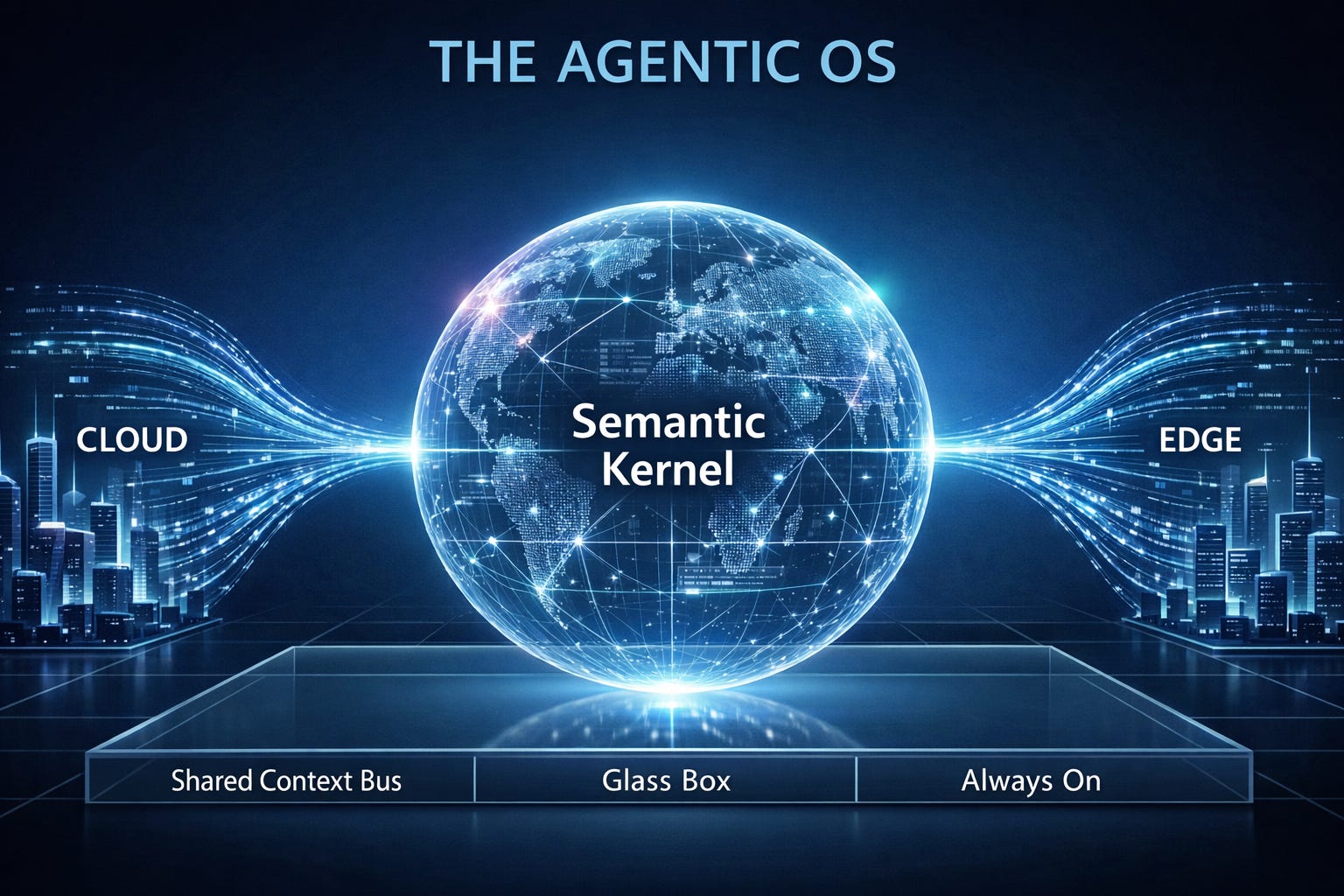
We must shift from AI-on-top to AI-at-the-center. In this paradigm, the large language model acts as a semantic kernel. It doesn’t just manage hardware interrupts; it manages user intent.
The Three Pillars of the AI Kernel
The Shared Context Bus: A system-wide “Semantic Memory” highway. It normalizes data from Cloud and Edge into a unified vector space, ensuring the agent has a single source of truth for user context.
Intent-Based APIs: Replacing traditional UI menus with semantic endpoints. Applications no longer just “receive clicks”; they “execute intents” provided by the Kernel.
Hybrid Resource Orchestrator: A routing layer that dynamically assigns tasks between the local NPU (for Privacy and Latency) and the Cloud (for Scale and Compute) based on a “Cost-per-Intent” metric.
1. Defining the Agent: The OPA Loop
In the legacy AI era (2022–2024), LLMs were primarily generative. In the agentic era, AI becomes active. The fundamental unit of value is no longer the token, but the loop. The system that wins will not be the one that writes the most eloquent paragraphs, but the one that closes the most loops.
We’ve built agents everywhere. Yet real agency still lives with the user.
Observe: The agent scans the environment (APIs, file systems, real-time data streams).
Plan: It decomposes a high-level “Mission” into a hierarchy of sub-tasks using reasoning frameworks like ReAct (Reason + Act).
Act: It executes across multiple tools without constant human hand-holding.
The Shift: We are moving from AI that speaks to AI that executes.
2. The Death of the Prompt: Intent-Based Computing
Prompt engineering is a leaky abstraction. It forces humans to contort their intent into machine syntax. In a true agentic OS, the prompt disappears and intent becomes executable. Users provide goals and constraints. The system handles translation and execution. The shift is decisive: the human moves from operator to architect, from typing instructions to defining outcomes.
The Strategic Wedge: The Intent-First API
To avoid boiling the ocean, the transition begins with a one-degree shift in how the Cloud and the Edge interact.
The “Wedge”: A unified Cross-App Intent API.
The Goal: Enable an agent to execute a workflow that spans the “Trust Gap” between local data and cloud services.
The Example: A user says, “Summarize the feedback from my last three Teams calls and update the ‘Risk’ column in my local Project Tracker.”
The Value: This proves the Shared Context Bus works by resolving identity and data permissions across the SaaS/OS boundary in a single, atomic transaction.
3. The Agentic Kernel: Reasoning as a Service
Much like a traditional kernel manages memory, the agentic kernel manages reasoning itself. It becomes the locus of judgment, not just execution.
Explainability as a Feature: The Kernel acts as the System Auditor. It generates a “Reasoning Trace” for every autonomous action. If an agent fails, the kernel provides a “Stack Trace” of its logic, making autonomy auditable.
Orchestration: The kernel determines which “model” or “tool” is best suited for a specific sub-task, optimizing for cost, latency, or precision.
4. Runtime vs. Response: Stateful Persistence
We are shifting from stateless transactions to persistent, stateful runtimes.
The Response Model (Legacy): You ask, it answers, the session clears.
The Runtime Model (Future): The Agentic OS is Always On. It maintains state across hours, days, or even weeks. It monitors for environment changes (e.g., a flight delay) and re-plans automatically. AI becomes a background process that you collaborate with.
5. The Trust Gap: Turning the “Black Box” into a “Glass Box”
The primary blocker for agentic AI is not intelligence. It is trust. By moving agency into the OS layer, we solve for safety more effectively than app-level guardrails ever could.
The Firewall of Intent: The OS can run a “Pre-flight Simulation” to verify if a proposed action aligns with user safety constraints before execution.
Red-Line Metrics: We define Task Completion-to-Failure Rate (TCFR) as a core SLO. We don’t ship “autonomous” features until they hit a rigorous “Safe Agency” threshold.
Observability: A “Transparency Dashboard” allows users to see why an agent made a decision, providing a “Glass Box” view into the AI’s reasoning.
The Opportunity: Building the Cognitive Infrastructure
The transition to an agentic OS means we are no longer just chatbot users; we become architects of outcomes. When intent becomes executable, clarity becomes leverage. In a world where systems can act, defining what should be done becomes more valuable than describing how to do it.
If we win the AI OS layer, we move from being a provider of productivity tools to becoming the fabric of daily life. We do not just provide capabilities; we define how intent becomes action.
That is power.
The real question is not whether agentic systems will arrive. They will.
The real question is who will control the kernel where judgment lives, and whether we will have the discipline to build systems worthy of that authority.