

We are living in a moment where feedback loops are shorter, consequences are faster, and there is less room to hide behind process or momentum. Hard things are arriving sooner, louder, and more publicly than before. That makes reflection less optional, and direction more consequential.
Hard Moments as Mirrors
The hard thing isn’t that circumstances are hard: they are hard because of what they reveal in us. Hard moments act like mirrors. They reflect back the parts of ourselves we’ve been outrunning, anesthetizing, or propping up with momentum.
During the height of the pandemic, I hit what felt like the mother of all challenges: professionally, relationally, physically, academically, and through a failed startup. A true pentafecta, without even accounting for the weight of a global crisis. Going back to my “why” wasn’t enough. That stall exposed something uncomfortable:
How tightly my internal reward system was tethered to motion.
How quickly my patience thinned when feedback loops broke.
How instinctively I equated worth with output rather than identity.
Hard things don’t introduce new problems; they surface old ones.
Why Hardness Is Misunderstood
We tend to frame hard things as external obstacles: markets, bosses, timing, or technology. But more often than not, hardness isn’t about external noise; it’s about internal confrontation.
Avoiding that confrontation has a cost. We override intuition, outsource judgment, and start performing instead of living in alignment. We don’t fail loudly, we drift quietly. Ben Horowitz makes a related point in The Hard Thing About Hard Things, noting that there are no formulas or silver bullets for leadership when things break down. Hard moments remove cover and force leaders to confront reality without hiding behind process or theory.
This requires a shift in how we think:
Easy seasons reward System 1 thinking: fast, instinctive, and frictionless.
Hard seasons demand System 2 thinking: slow, deliberate, and costly.
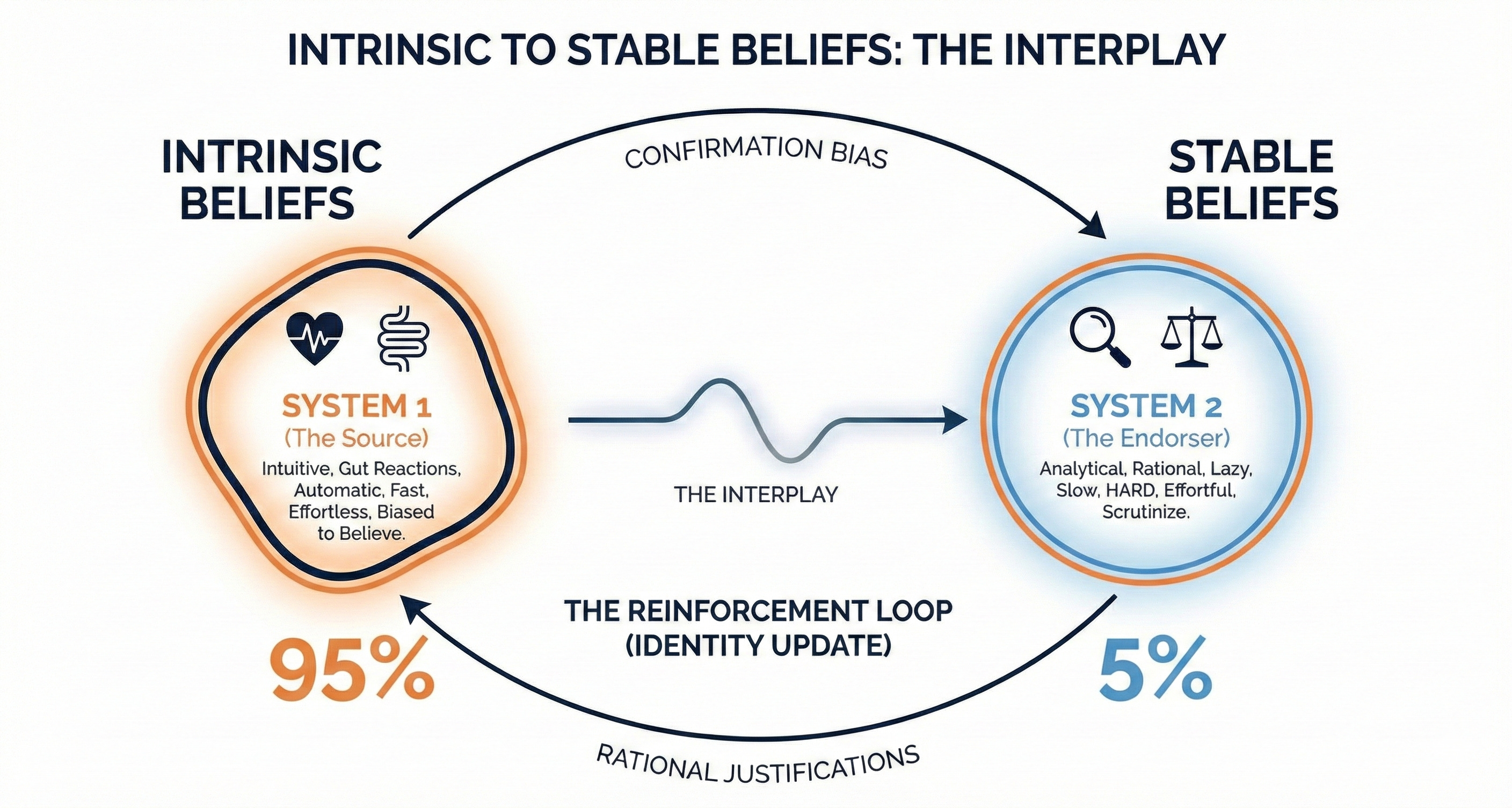
We often resent that cost, treating it like a bill instead of the price of participation. Hard moments interrupt our default loops and demand conscious engagement.
What Hard Things Actually Reveal
Hard things don’t just test us; they diagnose us. They reveal:
Character under pressure: When optionality disappears and there’s no elegant exit, who are you?
Values in conflict: Easy seasons let you honor everything. Hard seasons force tradeoffs.
Emotional defaults: Do you tighten control, withdraw, distract, perform, or blame? These patterns run quietly until stress turns the volume up.
Identity (Fragile vs. Grounded): When momentum stalls, what feels threatened: status, competence, relevance, or belonging?
Hard things don’t attack us; they expose what’s already there. What was once episodic in our lives is now systemic.
Why Technology Amplifies This
Technology doesn’t create pressure; it removes the buffer that used to hide who we are under it. In my own life, it took a massive “stall” to expose how tightly my worth was tethered to motion. But the current technological moment, particularly the rise of Agentic AI, offers no such pause.
What we are witnessing is a compression of time. Every major revolution, from the factory to the office, forced a reckoning, but never at this velocity. Today, the distance between pressure and exposure is shrinking. Hard moments arrive faster and more publicly, leaving little room for the slow, deliberate reflection we actually need.
This speed traps us in System 1 thinking: fast, instinctive, and “biased to believe” in the momentum of the next release. We see this most clearly in the debate over AI Trustworthiness. The “avoidance path” is to treat trust as a purely technical problem, optimizing for benchmarks and guardrails while assuming alignment will simply “emerge” later. This is System 1 at work: prioritizing frictionless motion over the “costly” internal confrontation of our own incentives and responsibilities.
Engagement in the AI era demands a shift into System 2 thinking:
Slowing down when every market incentive rewards acceleration.
Naming risks before they are reputationally convenient.
Accepting responsibility instead of deferring to automated frameworks.
The “Hard Thing” isn’t the AI itself; it’s resisting the urge to outsource our judgment. Avoidance doesn’t remove difficulty; it delays it until it returns at a scale we can no longer control.
The Cost of Avoidance
There are two paths when discomfort shows up:
The Avoidance Path: Distraction, optimization, and narrative rewrites.
The Engagement Path: Staying present and letting the mirror do its work.
Avoidance shows up when we relabel deep questions as “someone else’s problem.” When we optimize for performance metrics while quietly assuming alignment will follow, we create a misalignment between what we build and what we claim to value. This pattern shows up everywhere: in the health decisions we postpone, the relationships we avoid naming, and the institutions that optimize for appearance instead of trust.
The Invitation (Not the Solution)
The hard thing isn’t surviving the moment; it’s resisting the urge to numb what the moment is trying to teach you. Hard things aren’t punishments; they are diagnostic tools that refine your trajectory.
When you are faced with something that won’t yield easily, ask yourself:
What is this situation asking me to confront?
What part of me is being exposed, not attacked?
If this weren’t happening to me, but for me, what would it reveal?
Direction isn’t tested when things are easy; it’s tested when hard things remove the noise. This isn’t about feeling good. It’s about seeing clearly.
Andy Michel
☕ The Weekend Brew